
Join the Resistance
Useful drilling resistance is not a fixed percentage. It changes with the technique, your experience, and what you need to learn that day.
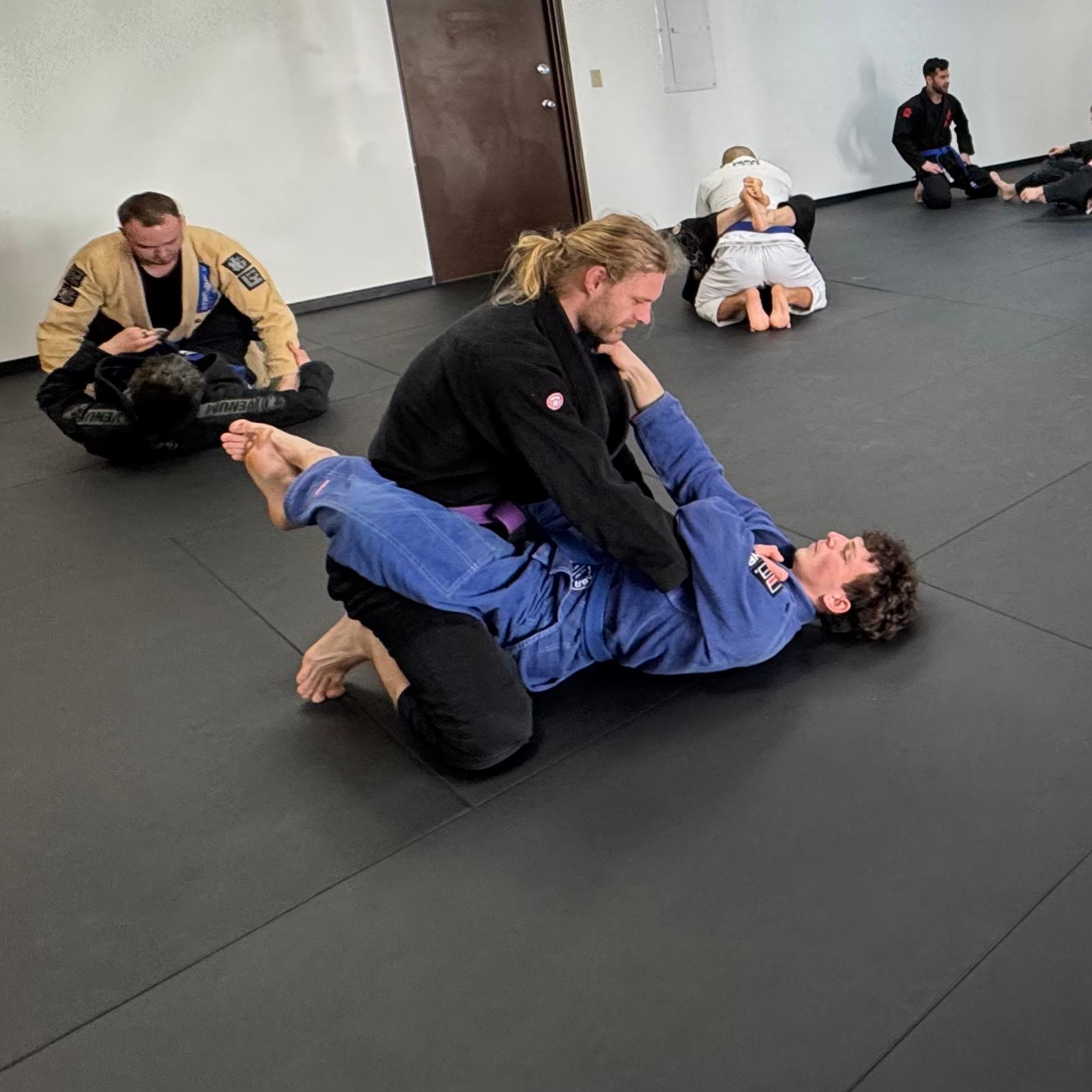
Useful drilling resistance lives somewhere between zero and 100 percent. It should make the technique necessary without making the learning process impossible.
Imagine your sparring partner could read your mind.
They would know exactly what you were going to do. They would know which grips you wanted, where you wanted to be, and when you planned to get there.
It would be nearly impossible to do what you wanted because they could predict every move and stop it before you were able to accomplish anything.
Sometimes sparring with a particularly good practitioner feels exactly like that.
Sometimes we marvel at it. We wonder, “How did they know I was going to do that?” Other times, we get frustrated because we could not do anything at all.
Now imagine that same sparring partner had less structure than a jiu jitsu training dummy.
You could do whatever you wanted, but they put up so little resistance that you would not have to do much of anything. You could walk past their guard as easily as a gentle breeze could blow them over.
For some, that might feel like expert-level jiu jitsu. More likely, because you probably enjoy doing jiu jitsu, it would feel like you could be anywhere else doing anything else. It would be a waste of your time.
People who like jiu jitsu generally like challenges. That is not all that unusual. Plenty of people enjoy being challenged.
But there is a difference between being challenged and being stopped completely.
At the same time, we want hard things to become easier. We feel accomplished when something that used to be difficult becomes easy for us, especially if it is still difficult for other people. It is the feeling of putting the last piece into a puzzle, finally hitting that three-pointer, or playing the part of a song that always tripped you up.
We want to be challenged, but not so much that progress becomes impossible. We also want the satisfaction of making difficult things easier.
That was a long setup, but I think it paints the right picture.
This blog is not about sparring partners.
It is about drilling partners.
Your drilling partner does not need to read your mind. They already know exactly what you are trying to do.
They know which grip you want. They know which direction you want to move. They know when you are going to start and the position you are starting from.
At 100 percent resistance, that advance knowledge makes stopping one particular technique relatively easy. If we are drilling a knee cut, our partner can prevent the grip, build their frame before we move, or change their posture so a knee cut no longer makes sense.
At zero resistance, we have the opposite problem. We may complete the pass, but if our partner has no structure, we might have to hold them up just to perform it.
At that point, why use a knee cut at all? Why not simply walk around their guard?
Neither extreme gives us a particularly useful version of the problem.
Drilling a move is a collaborative effort. We need enough of a challenge that the move remains necessary and resembles something we might encounter during sparring. At the same time, it cannot be so difficult that the learning process stops completely.
The difficult part is deciding what “enough” means.
The Agony of Percentages
If you are trying jiu jitsu for the first time and I give you what feels like 50 percent resistance to me, it may still be too much for you to understand the position.
Then I ask you to give me 50 percent resistance. Do you even know what that means? You may believe you are giving me half of what you have while giving me nearly everything.
Clearly my 50 percent is different from your 50 percent.
If I ask a one-year white belt and a seasoned brown belt for 30 percent resistance, they will almost certainly give me something different, even if they are roughly the same size and strength.
Do I need 30 percent resistance when working through a position? Should I ask for more? How much do you need? When should I stop resisting and allow you to recognize what is working, what fell apart, and what you should do next?
The percentage may be less important than what we want the repetition to teach us.
If it is our first time learning a technique, we often need a predictable structure. Our hands and feet need to find the “right” places. Our partner may need to limit their movement so we can understand where to go and why those details matter.
That does not mean they should collapse. They still need enough posture, weight, and structure for the technique to have something to accomplish.
As we gain experience with the move, we may want more realistic resistance. That resistance gives us more problems to solve before reaching the end position. Sometimes that is the best way to move beyond the most basic understanding of the technique.
As we gain experience, we should take more responsibility for deciding what we want the repetition to teach us and communicate that to our drilling partner. Our partner should not quietly decide that the repetition needs to become harder.
There may be days when we want more repetitions of the movement. Rep after rep of putting a hand here, moving our body there, blocking a frame, and finishing the technique.
On another day, we may want our partner to rebuild their frame after we remove the first one. We may ask them to turn a particular way as we enter the position or create the next logical problem in the sequence.
Maybe we encountered that reaction during sparring. Maybe we already understand the first part of the movement and want to sharpen what comes next.
Both kinds of practice can be useful. They are simply asking different questions.
Ask ten black belts how to perform a knee cut and you will probably see ten different knee cuts. They may finish in roughly the same position, but the grips, angles, pressure, and steps used to get there may be different.
My knee cut is not wrong simply because someone else does theirs differently. Or maybe mine is wrong. I'm human, after all. But disagreement over some of the details in the middle of the pass does not automatically make either version wrong.
One black belt may be expecting a particular frame. Another may be solving the problem created when their partner turns their hips. Someone else may use a grip that makes sense for the reaction they usually receive.
The knee cut is a basic pass in the sense that most of us learn it early. That does not mean we finish learning it right away.
At first, we may need one version against one predictable response. As our understanding grows, our partner can provide more structure and more realistic reactions.
The frame can become stronger. They can replace it when we remove it. They can shift their weight, turn their hips, or begin recovering the space we are trying to take away.
This is where more of those ten knee cuts begin to make sense.
The version we learned first may no longer fit the response we are receiving. Another variation may give us the grip, angle, or pressure we need.
That does not make the first knee cut wrong. It means the problem changed.
Jiu jitsu can often be an “if this, then that” type of martial art.
If our partner gives us one frame, we address it one way. If they turn their hips, we follow them or change our angle. If they abandon that defense entirely, we stop solving a problem they are no longer giving us.
What began as one straight path starts developing branches. The knee cut is still the knee cut. We are simply learning more of the situations in which it can exist.
The person receiving the technique is learning too.
Someone new to jiu jitsu may not know how people commonly defend a knee cut. They may not know where a frame belongs, which direction to turn, or what space they should try to recover.
When we give them a likely response to use during drilling, they begin learning the other side of the technique. They learn what makes the knee cut more difficult. They also learn what the passer might do when that defense is answered.
At zero resistance, a technique can appear to work without being necessary. At 100 percent resistance, our partner can turn the technique we are studying into a different problem entirely.
Somewhere between those extremes, resistance becomes part of the instruction.
Where that point sits will change with the technique, our experience, and what we are trying to understand that day.
A beginner may be learning where their hands and feet belong. An upper belt may be exploring what happens when a familiar response becomes stronger or arrives sooner.
The technique may be basic or advanced. We may be seeing it for the first time or returning to it for the thousandth.
Either way, the resistance should help us explore the problem we came to solve.
Enough to make the technique necessary.
Not so much that it becomes impossible.
See you on the mats.
Joshua is the owner and head coach at 608 Jiu Jitsu in Cross Plains, Wisconsin. He writes about learning, problem solving, and becoming a better training partner through jiu jitsu.