
Now What?
The tournament is over. What happened there can help you decide what deserves your attention next.
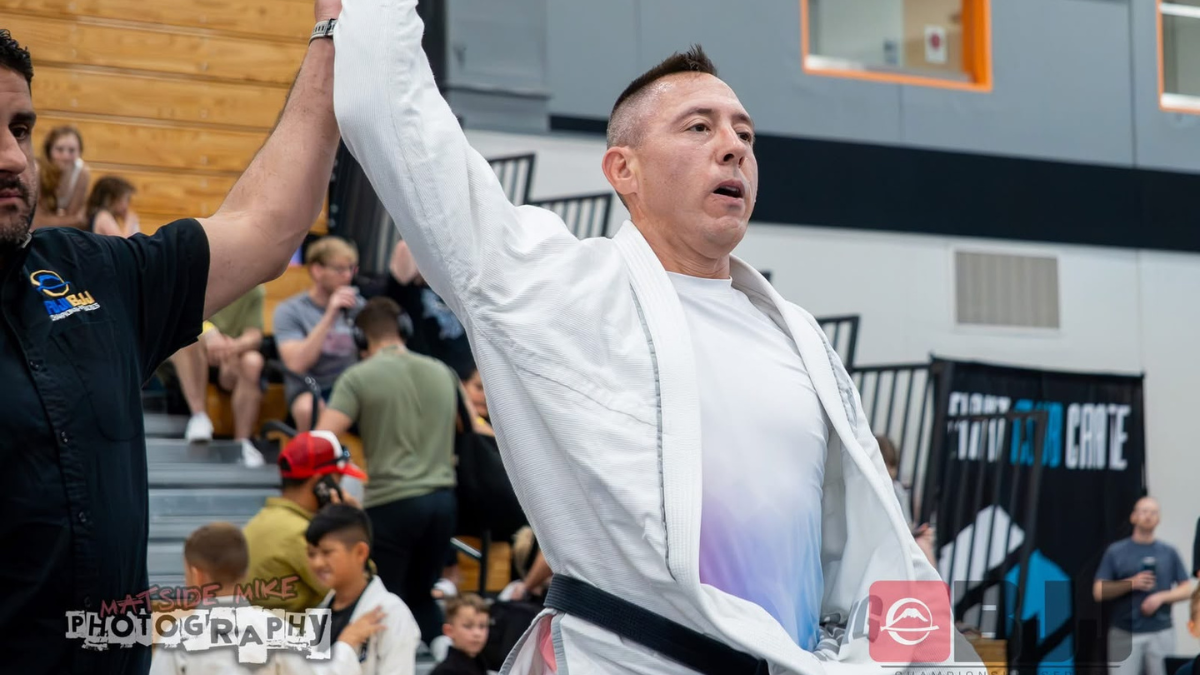
Competition can reveal which parts of your jiu jitsu hold up under pressure. Returning to those positions with intentional training gives you a chance to understand the problems and build techniques you can trust.
For anyone who competes, there is a process.
Sometimes it's cutting weight. Sometimes it's identifying which positions you want to stay out of and which positions you want to force your opponent to play. Sometimes that process is dealing with the nervousness leading up to the event. We prepare in any number of ways.
Then the tournament happens. You might have several matches during the day, but each match only has one winner. Whether or not your hand gets raised, eventually your tournament day ends.
Maybe you leave with a medal. Maybe you don’t. Either way, you prepared, you competed, and then the tournament is over.
Now what?
Choosing What Comes Next
There are several options. You could quit jiu jitsu. You have done enough to prove that you either can win or cannot win, so what reason could you possibly have to continue?
This is silly, and you should never, ever quit jiu jitsu.
You could keep training exactly as you did before. Whatever the results were, maybe you are here to have fun, and you thought it might be fun to try a tournament.
This is perfectly reasonable. But even the things we do for fun are usually more fun when we get better at them.
Or you could look at what happened and use it to decide what deserves your attention next. Now, if it were me, and it is, since I competed too, I would choose the last option.
What Competition Shows Us
Competition has a way of showing us what we are good at, what we only thought we were good at, and what we are not particularly good at yet. It can also show us which parts of our jiu jitsu we actually trust.
Which positions did you try to reach? Which positions did you avoid? Which techniques did you continue attempting? Which of those choices held up when put to the test, and which fell apart?
Competition does not always bring out the best version of our jiu jitsu. Sometimes nerves, exhaustion, or the pressure of the moment get in the way.
But it does show us the version of our jiu jitsu that appears when someone is doing their level best to stop us. That makes it particularly useful to study.
I have had this happen in my own jiu jitsu. At blue belt, I thought I was pretty good at deep-half guard. By purple belt, I felt even better about it.
Something Specific to Work On
Then, in competition, it completely fell apart. That gave me something specific to work on.
When I got back to training, I focused on deep-half for over a year. I found better ways to enter the position, better ways to stay out of trouble once I got there, and more dependable ways to finish sweeps.
Not to toot my own horn, but I might actually be pretty good at deep-half now.
Competition did not prove that deep-half was a bad position for me. It showed me that if I wanted to rely on deep-half, I still had work to do. That is the opportunity a tournament gives us.
The result alone does not determine what needs improvement. You can lose a match while doing several things well. You can also win a match while leaving behind plenty of problems that need attention.
Beyond the Result
This fits into the recent discussion about strength and technique. We can sometimes fill holes in our technical knowledge by applying more strength. In ordinary training, that may work well enough to let us move on without examining the problem too closely.
Those repairs tend to erode quickly when someone in a tournament is trying their hardest to beat us and leave with a gold medal.
So when we look back at a competition, we need to be honest with ourselves about what actually happened.
Not just whether we won or lost. Not just whether a technique worked or not. But what worked, what failed, and what choices led us there.
The tournament can show us where the problems are. But during a match, there is very little room to experiment. You rely on what you already know and what you already trust. There is rarely time to try something that has not already been tested.
Back to Training
So what should we do when we get back to training after a tournament? Intentional training.
We can return to the positions that gave us trouble. We can start a round from there, slow the position down, and try to understand what went wrong. We can repeat the same problem with different partners, try different answers, and gradually add more resistance to see which ones hold up.
The goal is not necessarily to win every one of those rounds. The goal is to build a technique we can trust.
Competition shows us whether that technique holds up under pressure. Intentional training gives us the opportunity to make it more reliable before the competition pressure returns.
Joshua is the owner and head coach at 608 Jiu Jitsu in Cross Plains, Wisconsin. He writes about learning, problem solving, and becoming a better training partner through jiu jitsu.