
Exclusions Apply
When “that’s my game” starts leaving things out.
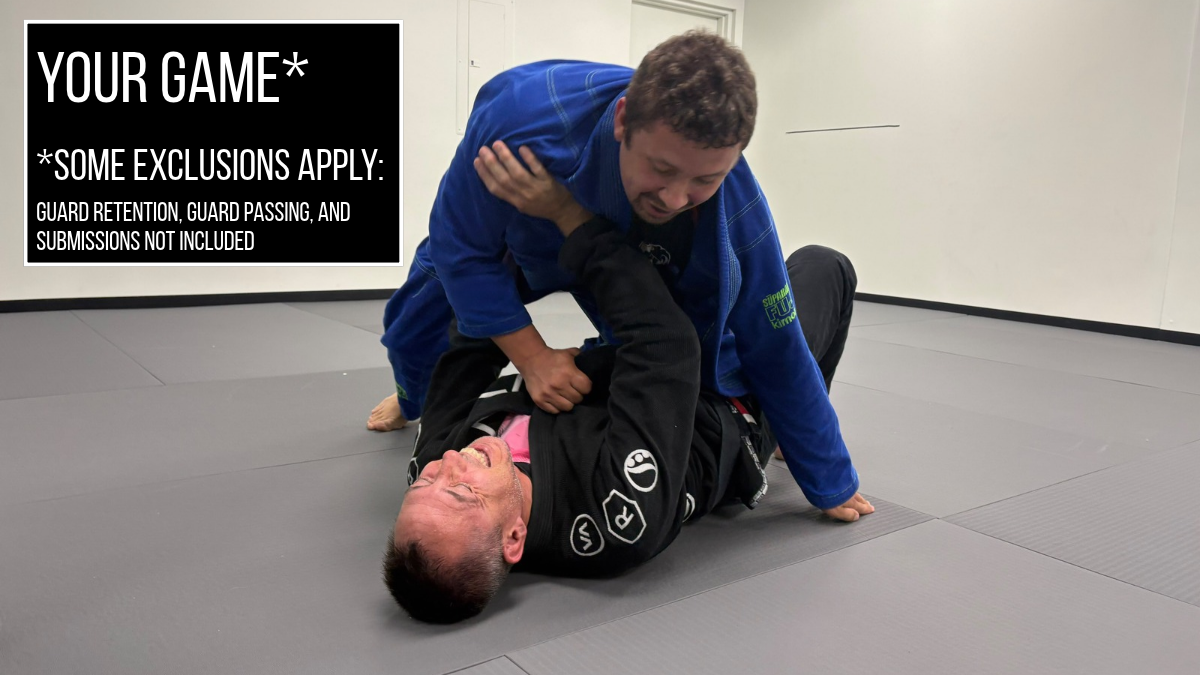
Having a preferred game can help you focus your practice. It also helps to recognize what you have left underdeveloped, so you can work toward the positions you want from the ones you would rather avoid.
For a long time, I thought of myself as a guard player. Looking back, “bottom player” would have been more accurate. Having a guard was nice, but I tried to make myself a problem from any bad position, whether I had a guard or not.
When I first started doing jiu jitsu, I was always getting swept. My guard mostly consisted of trapping a foot with my legs and hoping people couldn’t get free. I figured I should stop fighting the inevitable sweep or guard pass and learn how to stay safe in the positions I kept ending up in.
It didn’t always work out for me, but I started finding things I could do from underneath. And when guard retention was so much work, why not let people pass and try to be just as much of a handful there?
Let me be clear, for most people, I would recommend having a guard. There are some fairly good reasons we teach those.
Because I accepted being on the bottom so much, my top game was pretty lackluster. I wasn’t nearly as dangerous there. I had things I could do, but I felt more comfortable underneath, so that’s where I preferred to work.
That was my game.
It was also a pretty convenient explanation for why I wasn’t spending much time getting better at the other part.
Not Available in All Areas
There’s nothing wrong with having a preference. If you enjoy a position and spend time learning how to work there, you’ll probably keep finding reasons to come back. That’s part of developing your own jiu jitsu.
But “I like playing guard” and “I don’t need to work on passing” are two different statements. It’s surprisingly easy to start with one and behave like you said the other.
I’ve heard people say they don’t like mount because they don’t know what to do up there. Plenty of people have told me closed guard is boring, so they stay away from it. Just because you don’t work on your closed guard doesn’t make it boring. I feel like my closed guard is pretty exciting, exciting enough that I would watch it on primetime TV.
I often tell people to focus on one thing rather than trying to get better at everything at once. I still think that’s good advice. You need enough time with something to understand it.
But spending time on one thing doesn’t mean you’ve been excused from learning the rest.
If you like playing guard, what happens when you sweep someone? You worked to get on top. It would be nice to have something to do other than let them back on top.
If you’re good at escaping bad positions, that’s useful too. Especially if, like me, you’ve been too lazy to stop people from putting you in bad spots. But can you stop them when you choose to not be lazy, or is that just your game now?
That’s where I think it helps to look at what you call your game. Some of it may be a preference you’ve spent time developing. Some of it may be what you’ve avoided learning to do because it needs too much work.
Mine was a little of both.
Additional Features Included
This gets interesting when your personal attributes make certain parts of your jiu jitsu work a little better for you.
Maybe you’re strong. Maybe you’re flexible. Maybe you’re fast enough to get away with a decision that would have been a fairly bad idea at my speed.
Those things can influence what you like and how you move. They’re useful. I’m certainly not asking anyone to become less athletic so the rest of us can feel better. Unless that would work, because if it would...
But is being strong a game? Is being flexible a game?
Those attributes are tools and give you things to work with. What you learn to do with them tells you more about your jiu jitsu.
If you’re good at stopping someone’s escapes from side control, what can you set up from there? Can you threaten a submission or move to another position without losing control? Holding someone down gives you something useful to build on, but there’s still plenty to learn about what comes next.
If your flexibility often gets you out of trouble, can you recognize how you got into that trouble in the first place? Can you stop it from happening the next time?
When something keeps working, it’s easy to overlook the part that still needs work. I was finding things to do after people passed my guard. That didn’t mean I’d figured out how to keep them from passing it.
Availability May Vary
Eventually, I developed more of an appreciation for top position. Gravity was already doing some of the work for me, so why not take advantage of it?
These days, I generally prefer being on top. I still value what I learned in bad positions, including how to create problems when I’m somewhere I’d rather not be.
The difference is that I don’t consider bottom position someone else’s department now that I prefer top. I might end up there whether I like it or not, and I’d like to have something useful to do when that happens.
Knowing what to do in a position I wouldn’t choose can help me get somewhere I would rather be. Sometimes it gives me an opportunity I wouldn’t have noticed when I was busy deciding that part of jiu jitsu wasn’t for me.
You can have a game and still work on the things around it. You don’t have to like every position equally, or turn every technique into a personal favorite. But it helps to have an answer when the round takes you somewhere your favorite move doesn’t.
“That’s not my game” might be a perfectly accurate description.
Unfortunately, it doesn’t get you out of side control.
See you on the mats.
Joshua is the owner and head coach at 608 Jiu Jitsu in Cross Plains, Wisconsin. He writes about learning, problem solving, and becoming a better training partner through jiu jitsu.